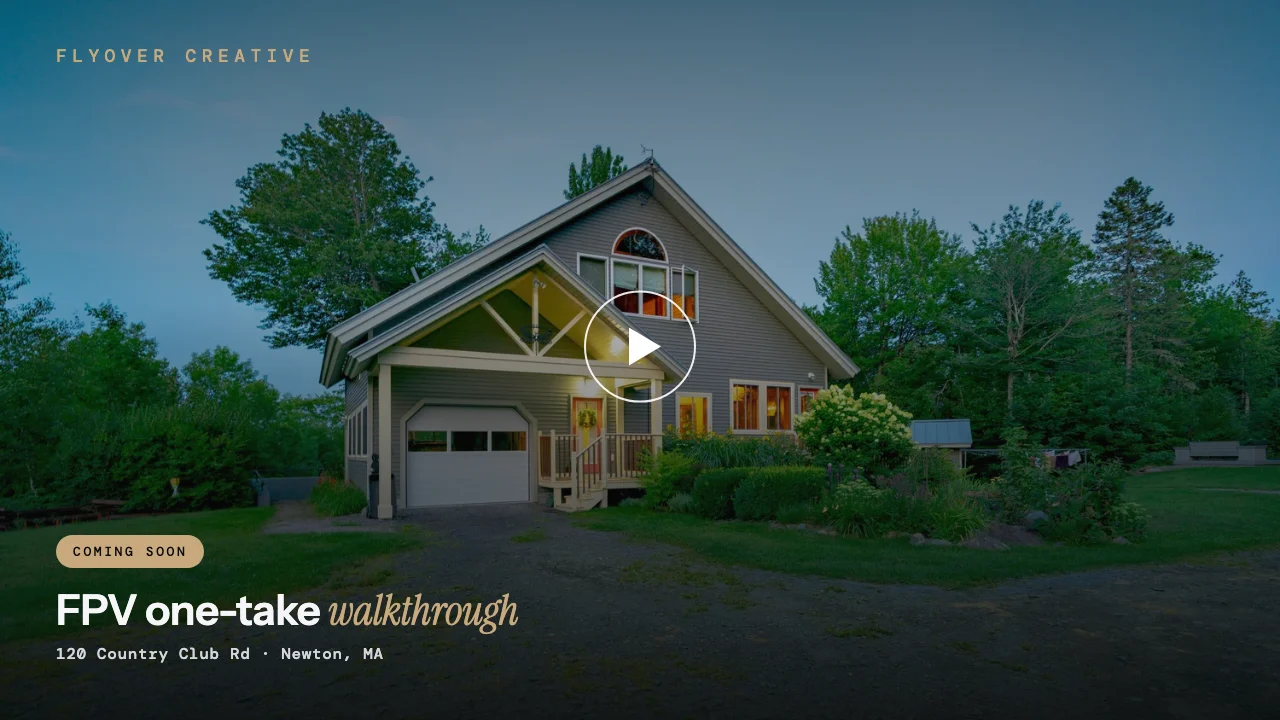
Scroll a few luxury listings in Weston or Wellesley and you'll see the shift: instead of a slow aerial orbit and a cut to interior stills, the camera glides up the driveway, through the open front door, down the hall, up the staircase, and out a second-floor window to the water — in one unbroken take. That's an FPV cinematic flythrough, and in 2026 it's quietly becoming the signature move on flagship Greater Boston listings. Here's what it actually is, why it works, and when it earns its place in the budget.
The short answer
An FPV ("first-person view") drone is a small, agile aircraft a pilot flies manually, capturing one continuous shot that moves through a property the way a buyer would walk it — only smoother and faster. On the right home it produces the single most engaging piece of media a listing can have: a tour people watch to the end. It's not for every listing, and in the Boston metro it carries real airspace and safety requirements. Used well, on the right property, it's the closest thing to walking a buyer through the front door before they ever book a showing.
FPV vs. a traditional drone — why the difference matters
For a decade, real estate aerials meant a GPS-stabilized camera drone (a DJI Mavic or Phantom) doing smooth, slow exterior orbits — great for roofline, lot lines, and setting, which is still the job of aerial photography. But those drones were built for wide, gentle outdoor moves and aren't suited to flying through a house: they're large, rely on GPS that drops indoors, and have exposed propellers.
FPV drones changed that. They're small, manually flown for precise acrobatic control, and fitted with ducted propeller guards that make it safe to fly inches from walls, furniture, and people. That's what unlocks the "flythrough" — a single continuous shot that can start outside, cross the threshold, travel room to room, and exit to the back patio without a cut. Where a traditional drone shows you the house from above, FPV takes you through it.
Why it works for a listing
It solves the floor-plan puzzle
A standard photo gallery makes buyers mentally stitch the home together — kitchen here, living room there, deck somewhere off the back. An FPV flythrough shows the property in motion, connecting every space into one continuous spatial narrative. Buyers instantly understand how the home flows. That's especially valuable for open-concept layouts, multi-level homes, and the indoor-outdoor transitions that sell a Hingham or Marblehead waterfront property.
It directs attention — in your order
A flythrough is choreographed. The pilot leads the viewer past the chef's kitchen, into the primary suite, and out toward the view in exactly the sequence that builds value. That directorial control is something a static gallery can't replicate, and it's why a well-cut flythrough holds attention where a slideshow loses it. For how this fits alongside stills, see our guide to photography vs. video for Boston listings.
It's built for the vertical, social-first feed
Listing video doesn't live only on the MLS anymore — it lives on Reels, TikTok, and YouTube Shorts, where the frame is vertical (9:16) and the first two seconds decide everything. FPV is tailor-made for it: flying straight up a staircase or down a hallway creates a sense of depth and speed that "pops" on a phone in a way a horizontal pan never will. One shoot becomes the cinematic hero for the website and the scroll-stopping vertical cut for social — the kind of two-jobs-from-one-shoot thinking we cover in our marketing playbook for Boston agents.
The Greater Boston reality: airspace and safety come first
FPV doesn't change the law — it raises the stakes on getting it right. Any drone flown to market a listing is commercial work requiring an FAA Part 107 certified pilot, and almost the entire Boston metro sits in controlled airspace ringed by Logan, Hanscom, Norwood, and Beverly, where LAANC authorization has to be pulled before the flight. Some grids near Logan read zero feet and have to be planned around. The exterior portion of any flythrough over Boston, Cambridge, or Brookline lives under those same rules — our full drone-laws guide for MA, NH & Maine walks through them. Indoors, the safety bar is the ducted-prop FPV rig and a pilot who's flown the move before, not someone improvising near your client's furniture. Ask any provider two questions: "Will you pull LAANC for this exact address?" and "Is your indoor rig prop-guarded?" The right answers are yes and yes.
When an FPV flythrough is worth it
It's a flagship tool, not a default. Match it to the property:
- Strong fit: luxury and architectural homes, open-concept layouts, multi-level homes, and properties with a dramatic setting or indoor-outdoor flow — where the journey through the home is the selling point.
- Usually skip: entry-level units, choppy or compartmentalized floor plans, and listings where a clean photo gallery plus a standard cinematic video already tells the story.
- Pair it: an FPV flythrough is the headline, not the whole campaign — it works best layered with a full daytime gallery, exterior aerials, and a twilight hero shot for the most-clicked exterior.
The bottom line
The FPV flythrough is the most immersive piece of media a Greater Boston listing can carry in 2026 — a single, choreographed take that lets a buyer feel the home before they ever walk it, and a vertical cut built to stop the scroll. It's not right for every property, and it has to be flown legally and safely in this airspace. On the right flagship home, nothing else markets the experience of the house the way it does. Tell us about your next listing and we'll check the airspace for the address and tell you honestly whether a flythrough is the right call.
Frequently asked questions
What is an FPV drone flythrough for real estate?
It's a single, continuous video shot flown with a small, manually piloted FPV ("first-person view") drone that travels through a property in one unbroken take — often from outside, through the front door, room to room, and back out. Ducted propeller guards make it safe to fly indoors near walls and furniture, which a standard GPS aerial drone isn't built to do.
How is FPV different from regular drone photography?
A traditional drone captures the home from above — roofline, lot, and setting — which is the job of aerial photography. An FPV drone is small and agile enough to fly through the home, producing a continuous cinematic flythrough that shows how the spaces connect. Most flagship listings use both: aerials for context, FPV for the immersive tour.
Do you need a licensed pilot to fly FPV indoors in Boston?
Yes. Any drone flown to market a listing is commercial work requiring an FAA Part 107 certified pilot, and the exterior portion of a flythrough in the Boston metro needs LAANC authorization before takeoff because almost the whole area sits in controlled airspace near Logan, Hanscom, Norwood, and Beverly. Indoors, the safety standard is a prop-guarded FPV rig flown by an experienced pilot.
Is an FPV flythrough worth it for every listing?
No — it's a flagship tool. It shines on luxury, architectural, open-concept, and multi-level homes where the experience of moving through the property is the selling point. For entry-level units or choppy floor plans, a strong photo gallery and a standard cinematic video usually do the job. Ask for an honest recommendation on your specific property.