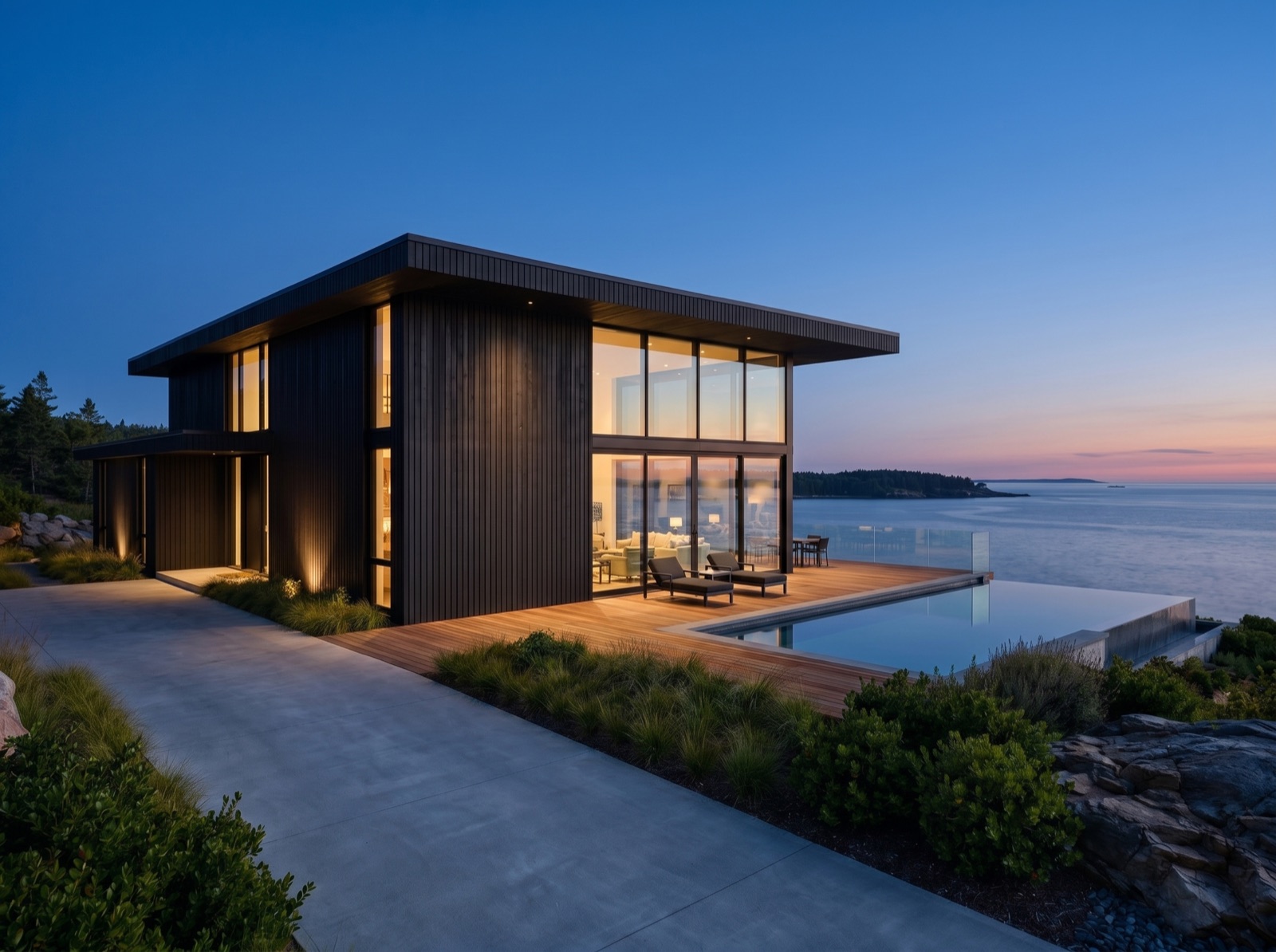
Twilight is the most powerful image a coastal Maine listing can carry, but only when the schedule lines up. Sunset moves by more than ninety minutes between January and June. Tides shift roughly fifty minutes a day. Marine weather along the coast changes inside a single afternoon. Get those three to agree and you produce the image that anchors the listing; ignore them and you fly through a flat sky over an exposed mudflat. Here is how an experienced operator schedules a coastal twilight shoot on Maine's coastline.
The two windows that actually matter
"Twilight" is a loose term. The image you want comes from a narrower window. Two stages of dusk are useful for real estate, and they look different.
Civil twilight (about 0 to 25 minutes after sunset)
The sun is just below the horizon. The sky still carries warm color in the west, the interior lights begin to read against the exterior, and the water reflects both. This is the warmer, softer twilight, and it is often useful for harborfront and view properties along Portland, Maine's Eastern Promenade, Falmouth Foreside, and the open ledges of Cape Elizabeth.
Nautical twilight / blue hour (about 25 to 50 minutes after sunset)
The sky deepens to a saturated blue. Interior lights are now the dominant source. This is the dramatic, cinematic twilight, and it is the standard hero image for architectural and modern homes — large glass facades reading bright against a deep blue sky over the water. Kennebunkport's shingle-style and modern coastal builds photograph especially well in this window.
Why tide stage decides whether you fly
Tide is the variable agents most often forget. The Gulf of Maine has one of the larger tidal ranges on the U.S. East Coast — often nine to eleven feet between low and high in midcoast Maine. That spread changes the look of a waterfront photo dramatically.
High tide and the hour either side
Water is up against the seawall, the dock, the rocks, or the ledge. The shoreline can read as a clean reflective edge and pick up the post-sunset color. For a harborfront home in Portland, Maine, an oceanfront ledge in Cape Elizabeth, or a tidal-river property along Scarborough's marsh, this may be the better stage after the exact property and conditions are checked.
Low tide
Eelgrass, mudflats, exposed pilings, and rockweed are all visible. For a working-harbor town this can be character; for a luxury listing it is usually a distraction the eye snags on instead of the architecture. Lobster boats sitting on their keels are charming in a coffee-table book and almost never charming for a buyer trying to picture the lifestyle.
The schedule rule
Aim for the twilight window to fall within roughly ninety minutes of high tide. When that alignment isn't available within the listing's launch window, prioritize the sunset window and choose the property angle that minimizes exposed shoreline.
The marine forecast: cloud cover decides the result
The single most useful weather data point for a twilight shoot is mid-level and high cloud cover at the time of sunset. A clear sky often produces a pleasant but flat blue. A fully overcast sky produces an unusably gray sky. A partial deck of high clouds — what the marine forecast calls "few" or "scattered" at altitude — catches the post-sunset color and produces the dramatic streaked sky that defines the best coastal twilight images.
What to check the day of
- NOAA marine forecast for the specific harbor or coastline.
- Cloud cover percentage at sunset — 20–60% is usually the sweet spot.
- Wind — sustained winds above roughly 20 mph at altitude shorten the flight time and can ground the drone entirely.
- Visibility — coastal fog rolls in fast; if the harbor is socked in, reschedule.
Sunset times in Maine — what the calendar actually looks like
Sunset along the southern Maine coast varies widely through the year. Approximate local times:
- January — sunset around 4:15 to 4:50 p.m. The twilight window is over by 5:30. Crews are usually packing up before dinner.
- April — sunset around 7:15 to 7:30 p.m. A 6:30 p.m. arrival is comfortable.
- June — sunset around 8:20 to 8:30 p.m. The twilight window extends past 9:00 p.m. This is the latest start, and the calmest evening light of the year.
- October — sunset around 5:45 to 6:15 p.m. Often the most cinematic stretch of the year — clear cold air, dramatic skies, and a manageable schedule.
The point: a "5 p.m. twilight shoot" in June is too early, and a "7 p.m. twilight shoot" in January is too late. Lock the schedule against the actual sunset time for that specific date.
Moon phase, lights on, and the small details
Two more variables that separate a strong twilight from a great one:
Moon phase. A rising near-full moon over the water during the blue-hour window adds a separate light source that reads beautifully in a wide-angle aerial. It only happens a few evenings each month, and a coastal-Maine operator who plans seven to ten days out can target it intentionally for a flagship listing.
Lights on. The listing's interior and exterior lights need to be on — every room, the landscape lighting, the dock or pier lights, the pool if there is one. This sounds obvious; it is the most common single reason a twilight shoot underdelivers. Plan it into the prep email to the seller.
No vehicles in frame. Move cars before the daytime portion and keep them moved through the twilight window. A Range Rover parked in the foreground is a visual anchor the buyer's eye can't ignore.
How this connects to the listing's launch
The strongest play is to shoot a few days before the property goes live. That gives the agent a hero image for the MLS, a second image for the email blast, a third for the social tease, and a vertical crop for Reels and Shorts. Pair the twilight hero with a complete daytime gallery and a cinematic video (see do listing videos sell homes faster for when video is worth it), and the launch carries weight all the way through the first open house. For a deeper look at the twilight-vs-daytime trade-off, see this companion piece.
Boston Harbor and the North Shore: same math, tighter airspace
Tides and sunsets behave the same way down through the North Shore, the Seacoast, and Boston Harbor itself, with a slightly smaller tidal range than midcoast Maine. The blue-hour window over the water in Rye, Portsmouth, NH, Newburyport, Gloucester, Marblehead, Hingham, and Cohasset follows the same rhythm and rewards the same planning. For a Portsmouth listing, start with the Portsmouth, NH media-selection guide to decide whether twilight and drone add useful setting context or whether the ground gallery should carry the story.
The one variable that changes closer to Boston is airspace, not light. Boston Harbor and the inner North Shore sit under Logan's Class B, so a twilight flight there needs LAANC authorization filed ahead of the shoot in addition to the tide-and-sunset math above; see the drone-law breakdown for MA, NH, and Maine for exactly what that requires by town. Once the airspace is cleared, the scheduling logic is identical to a Maine harbor shoot, and it pairs well with a full Boston drone photography package for the daytime gallery.
Frequently asked questions
How early do I need to book a coastal twilight shoot in Maine?
Seven to ten days out is the comfortable window. That lets the operator align the sunset time, the tide stage, the marine forecast, and any LAANC airspace authorization. Last-minute bookings still work for inland properties; coastal listings reward planning.
Does the tide really matter for a coastal twilight photo?
Yes. A high tide gives waterfront and harbor properties a continuous, reflective water surface that catches the post-sunset color. A low tide exposes tidal flats and rocks that pull attention away from the architecture. For most Maine luxury waterfront listings, a tide near high during the twilight window produces the stronger hero image.
What if the weather looks marginal that evening?
Coastal Maine weather changes fast. Hold the booking, recheck the marine forecast and cloud-cover model the morning of, and decide by mid-afternoon. A flat overcast sky is rarely worth flying. A partly cloudy sky with high clouds often produces the strongest result.
Can I do twilight on the same day as daytime photos?
Yes, and it is usually the right plan. A combined shoot day delivers the full daytime gallery plus the twilight hero in one trip, lower cost and faster turnaround. The crew shoots daytime through golden hour, breaks briefly, then resets for the twilight window.
Does Boston Harbor's airspace change how a twilight shoot is planned?
Yes. Boston Harbor and the inner North Shore sit under Logan's Class B airspace, so a legal twilight flight needs LAANC authorization filed before the crew arrives, on top of the usual tide and sunset planning. A licensed operator checks the grid ceiling for the exact address when quoting the shoot, since some grids near Logan read very low. See the full drone-law breakdown for MA, NH, and Maine.
The bottom line
A coastal twilight image is the single hardest-working asset on a Maine luxury listing — and the easiest to schedule wrong. Plan against the actual sunset for that date, target a tide near high, watch the cloud-cover forecast, and shoot a few days before launch. Done that way, the twilight hero pays for itself in the first week the listing is live.